I went to University in Boston. Don't ask me why but I had it in my head that I had to leave home after highschool, live in another city (another country, as it turned out), get some space from the town where my parents live, where I'd spent all of highschool and lived since I was 13 years old. What I learned while I was away was just how much I love being here, in Toronto. My Boston friends still laugh at the extreme enthusiasm with which I convince them to visit my hometown, but when they finally agree to come- Bostonians and New Yorkers all skeptical about Canada's greatness- the city never fails to win them over. Because it's the best place there is; that sounds hyperbolic, but I've been lots of places, and I've never found a city as vibrant and welcoming and just plain cool as Toronto.
In the past year, this firm-held opinion of mine has grown immeasurably due mostly to the influence one man has had on the artistic and cultural experience of Toronto. Downtown, in the heart of the ever-gorgeous Distillery District, sits the city's most valuable performance space: The Young Centre for the Performing Arts. The beautifully designed venue sports a spacious lobby with The William Hutt (*moment of reverence*) Library and a bar that serves everything from local beers and good wines to delicious espresso drinks, chai hot chocolate, gourmet sandwiches, soups and salads and the best fresh-baked cookies this side of my mother's kitchen. It's also home to no fewer than four diverse and convertible theatre spaces (not to mention studios, classrooms and offices). This space was built in 2006 to house George Brown College's theatre department and a little company called Soulpepper. Its General Director is Albert Schultz and it's from this perfect little slice of the city that he has designed and implemented more city-shaping initiatives than any other arts professional in recent memory. When I'm down in the Distillery, I'm in Albert Schultz's Toronto, and there's nowhere in the world I would rather be.
The Young Centre poobah is also (or, rather, coincidingly) the founding and current Artistic Director of Soulpepper, a thrilling repertory company that is in many ways the centre of Toronto's theatrical community. At only 15-years-old, Soulpepper easily rivals the acclaimed Stratford and Shaw festivals in the acting talent it attracts and with a year-round season of diverse works, it's the unrivaled go-to company for quality productions in Toronto. And Schultz is at the centre of it all as the face of the company as well as a participating actor and director.
The upcoming 2012 season hosts yet another lineup of promising productions covering all genres and periods. I'm particularly looking forward to seeing Kim's Convenience again, the 2011 Fringe festival hit written by Soulpepper Academy graduate Ins Choi, as it kicks off the new season on January 12th. In February, My Theatre favourites Evan Buliung and Gregory Prest will take on the intense Long Day's Journey Into Night with Soulpepper's go-to actress Nancy Palk in O'Neill's most demanding role, while the super wonderful Oliver Dennis and Mike Ross will appear with Diego Matamoros in High Life directed by Stuart Hughes. Schultz will direct Home in May and David Storch will take on Speed-the-Plow in July (Mamet's always done well for Soulpepper, being that they're mutually awesome and all). Big name Kenneth Welsh will return to the stage with The Sunshine Boys and Schultz will direct The Crucible followed by a remount of his hit production of another Arthur Miller piece, Death of a Salesman. Endgame (Lord help us all, but if anyone can convince me to like Beckett, it's Soulpepper), You Can't Take It With You, The Royal Comedians an A Christmas Carol round out the eventful season to come.
As an actor and performer, Schultz has quickly become a favourite of mine in my first year reviewing the company. He has an affable charm that makes him a superb figurehead (he can be seen wandering the halls of any Young Centre event, schmoozing and taking in shows) but he's also in possession of an incredibly unique blend of passion, seriousness and fun. Everything he does is executed seemingly effortlessly (the mark of a lot of effort) and he consistently has audiences eating out of the palm of his hand. Albert Schultz gives a sense of enthusiasm that's both unmistakable an infectious, a quality that's never more clear than at the Young Centre Festivals- weekend long events celebrating the arts, conceived by Schultz and the team and at The Young Centre (including 12 resident artists). A man whose job it is to run (and direct for, and act in) one of the most successful theatre companies in the country, you'd think would be content to just sit back and enjoy his work, but Schultz seems intent on supplementing it with celebrations of music and the spoken word at The Young Centre's Global Cabaret and Word Festivals.
Once a year, The Young Centre is filled with 3 days worth of Toronto's greatest musical talent at The Global Cabaret Festival. This year's was at the end of October, and it was the coolest weekend I've ever spent in this city.
The 4th annual showcase featured more than 150 musicians in 44 performances from Oct 28-30 and was composed of 3 types of cabarets: The Featured Artist Series showcased, well, featured artists, including some of Canada's most legendary talent (Jackie Richardson to Sharron Matthews to Daniel Taylor) performing their signature material. The Album Series was a set of tributes to the great artists and songwriters of the world (The Beatles, Paul Simon, Carole King, and more) music directed by the festival's resident artists and each featuring a plethora of guest stars. Finally there was the Theatrical Cabaret Series, which consisted of re)Birth: E.E. Cummings in Song, a Soulpepper original re-mounted from its earlier run, and The National Theatre of the World: The Carnegie Hall Show, a completely improvised musical event that was different at each performance.
I kicked my weekend off early Saturday afternoon at Albert Schultz's kids cabaret Young At Heart. The casually charming concert (which Schultz has performed for over a decade and recorded for the CBC) is a loving tribute to comedian/singers like Danny Kaye and a celebration of youthful wonder (he does a "cat medley" that includes "Everybody Wants to be a Cat", "Tigger" and "If I Were King of the Forrest", which he delivers in endearing goofy voices); it also features priceless contributions from the great Don Francks and Jackie Richardson. Housed in the Michael Young Theatre, beautifully transformed with cabaret tables and twinkling candles, Young at Heart was my favourite cabaret of the whole wonderful weekend and showed off exactly what it is that makes Schultz so incredibly good at the coolest job in the world.
Next, I was lucky enough to catch Jackie Richardson's own cabaret, a delightful hour of jazz and blues as delivered by one of Canada's most awesome performers. Richardson's show dragged only a little as she got lost in some of her more wandering anecdotes (most of which were simply hilarious) but the power of her voice and her engaging stage presence proved impossible to ignore.
Things slowed down from there when I wandered cluelessly into The Stan Rogers Songbook. Headed up by endearing performers like Miranda Mulholland and the endlessly charming Brendan Wall, I'm sure this particular cabaret was wildly entertaining to fans of Stan Rogers' downhome melancholy, but I found it a little less than rousing (through absolutely no fault of the performers). The reason I went was to see one of the featured guests, Mike Ross, who delivered a couple strong vocals and livened up the proceedings with some cute banter, an anecdote about his expected baby (6 days overdue by then) and some fake rivalry fun (he accidentally knocked over Wall's guitar). Standing in line for a later show I overheard the audience members behind me discussing the E.E. Cummings piece that Ross was a major contributor to: "That Mike Ross is a genius" is not an uncommon sentence to hear at The Young Centre but that doesn't make it any less true. I thought he was great as a conflicted sociopath in White Biting Dog, then amazing in Acting Up Stage's Leonard Cohen/Joni Mitchell tribute, but the boyishly charming multi-hyphenate seems to whip out another mastered skill every time I see him and impress me even more. I'm just sad that at The Global Cabaret Festival I only got to see him sing Stan Rogers.
Next up was Sharron Matthews, of whom I've heard much but seen very little. The exuberant singer lived up to expectations with one of the most fun cabarets of the whole festival. With more of a focus on storytelling than the rest, Matthews gave the outright funniest performance I saw, complete with her divalicious takes on popular songs and a vicious demand for the monstrous Rob Ford to "get out of office and we'll feel alright" (sung to the tune of Bob Marley's usually peaceful "One Love"). Matthews' exuberance comes with a certain degree of self-righteousness, earned from a bullied childhood and years as an industry underdog, but that can be forgiven when she makes the glasses tremble with her powerful belt.
After that, I made the mistake of trying to get into The Beatles's Abbey Road from the Album Series at 8:15, missing my last chance to see the E.E. Cummings show I'd missed earlier this year at Soulpepper. When The Beatles turned out to be too popular (duh!), I called it a night.
I spent my Sunday with a musician friend of mine who was working at the festival instead of scouting out the rest of the Featured Artist Series (I figured between Schultz, Richardson and Matthews I'd gotten my money's worth). After dinner, my media pass got me in to see the final few minutes of Prince's Purple Rain, which I was glad to have mostly missed after musical director Suba Sankaran's gratingly forced enthusiasm proved too much for me to handle.
At 9:15 I capped off my excellent weekend at Toronto's coolest yearly event with the most popular show of the festival: Abbey Road. It was alright, not as memorable as I would have liked. After some of the brilliant cabarets earlier that weekend and the example set by Reza Jacobs' innovative takes on the Mitchell/Cohen songbooks, I'd come to expect a little re-interpretation when dealing with songs as famous as a Beatles track. But with the exception of a little extra drumming, the famous tunes remained largely untouched, delivered prettily but with a somewhat disappointing sense of adulation.
But a few underwhelming shows aside, the Global Cabaret Festival was freaking cool.
The Word Festival, which took place 2 weeks ago, was a less glamorous affair just in its first year of existence, but the slightly nerdy low-key-ness of the weekend gave it a sort of passion project feel that made it all the more fulfilling.
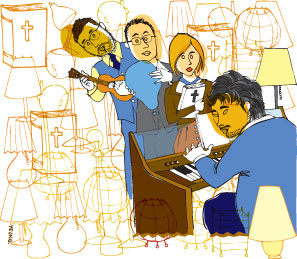
On the festival's opening night, Schultz MC'ed the Elmer Iseler Singers concert. He told a story about being a 15-year-old high school student asked to read Hamlet aloud in class. Most of the other students were struggling but he sailed right through, despite having never encountered Shakespeare before. He described the feeling of reading the verse like the experience of coming home, and realized that the reason he was so comfortable with the melodic, old-timey text was because he'd been raised going to church and singing in the choir; he'd been raised on the King James Bible. A classical acting career later, Schultz landed on the additional realization that we were in the year of the KJV (King James Version)'s anniversary, 1611, and that that was the same year Shakespeare produced his final play, The Tempest. So, for the 400th anniversary of 1611, Schultz and The Young Centre organized a celebration of the spoken word, honouring the publication of the two most influential texts in the English language- The King James Bible and The Complete Works of Shakespeare. It's a fascinating idea and resulted in a weekend of events, some utterly memorable, some wonderfully inspiring and some a little bit boring.
A main attraction of The Word Festival was the Live Reading of the KJV in the lobby of the Young Centre. 24hrs a day, 76 hours straight, someone was reading until the entire book had been spoken aloud at the festival. Soulpepper company members, the Young Centre resident artists and other prominent performers were called in to lend their voices to the reading, which concluded Sunday afternoon as Schultz read the final words and, punctuated by a fire alarm with a sense of humour, closed the book on Revelations. The whole thing streamed online, in case you were awake at 3:30am and just wanted to make sure they were still going, and was a fascinating thing to encounter as you moved from performance to performance.
Before the Elmer Eisler concert, the actual first event of the festival was a somewhat underwhelming introductory Shakespeare Panel that addressed the Bard's global influence. A Shakespeare nerd to the core, I was super psyched to hear from Professor Jill L. Levenson (who edited the Oxford R and J!) and Dr. Toby Malone (Soulpepper dramaturg, among other things). But what I found was that a panel discussion with festival artists (or, specifically, Schultz, if we're being honest here) would have been a lot more engaging. Academics like Levenson, though knowledgeable, can get caught up in theory (Levenson, for example, read from a prepared speech much of the time), whereas theatre actors/directors or just plain Shakespeare lovers are free-er to speak off-the-cuff, something Malone was much better at and panel guest Anthony Del Col (co-author of the comic book series Kill Shakepeare) excelled at. I would have loved to hear their in-depth thoughts about the texts themselves, to know which villain most inspired Del Col's narrative or pick Levenson's brain about what she thinks is the most important element in Romeo and Juliet. As it was, the stiff panel saw the expertise of its guests a little wasted.
But then I moved on to the Elmer Iseler singers for 2 hours of choral music that featured enough highlights to distract me from the fact that I was spending 2 hours listening to choral music. As narrated by Schultz, the concert was a lot more fun than expected. Reading corresponding Shakespeare and KJV passages, telling stories and cracking jokes, Schultz spread his love of choral music to the audience (as well as contributing some memorable sonnet reads and a truly great rendition of "All the World's a Stage" with the casual air of someone for whom Shakespeare is their native tongue). The singers themselves were beautiful, singing a combination of complexly harmonic contemporary pieces, some songs from Shakespeare plays and even a few jazz numbers accompanied by Gene DiNovi and Dave Young. They shone the brightest in the acapella numbers where their incredible layering really came through.
Next up was National Theatre of the World: Impromptu Splendor. The award-winning 3 person improv troupe's play series features a brand new hour-long improvised play at each performance, generally done in the style of a particular playwright (Mamet, Miller, etc...). At The Word Festival, NTOW did two performances: one inspired by the KJV and one inspired by Shakespeare. Though I'm sure I would have loved the latter, the former was the one that fit into my schedule and, though impressive, it was sort of underwhelming. The bible's just so abstract for long-form improv to use as inspiration, the stories themselves more allegorical than dramatic (and NTOW had the misfortune of finding an aged Solomon groupie in their front row, who tripped them up a bit by guiding them towards the Old Testament king and away from the much more well-known and therefore spoofable New Testament Jesus stories). The way that the three players picked up on each others' cues and and constructed stories on their feet was tremendous, making me wish all the more that I had gotten to see what they did later in the festival with the complete works of Shakespeare.
I returned to The Young Centre that Sunday for a jam-packed Word Festival calendar that made up for my missing Saturday (mostly, I only missed the Song of Solomon movement piece that I wasn't all that interested in and The Festival Cabaret, which I was very sorry to miss since it was hosted by, you guessed it, Mike Ross).
I started Sunday with The Gospel According to Mark, which I thought would be a dramatic interpretation but was in fact just a reading of "The Gospel According to Mark". But that reading was done by stage legend Kenneth Welsh and if there's one truth that was unavoidable at The Word Festival it's that you haven't heard the bible until you've heard it read by a proper Shakespearean actor. Welsh, whom I've never actually seen perform outside of The Word Festival, gave a spectacular reading- grand and evocative, surprisingly funny at times. Nonreligious as I am, I may have zoned out from time to time (it was 2 hours of just bible, after all) but the overall effect was a powerful one.
Besides, I had all sorts of fun to look forward to at my next performance- my most anticipated of the festival. I first heard about Kill Shakespeare when Stratford Festival Assistant Artistic Director Dean Gabourie gushed about it in his My Theatre Nominee interview earlier this year. I'd been in touch with co-creator Anthony Del Col about an interview for sister site My Books, but had simply run out of time and never gotten around to reading the comics. So I was beyond thrilled when The Word Festival hosted a staged reading of the series. Creators Del Col and Conor McCreery were joined on-stage by some of Soulpepper's best talent (including Prest, Malone, Wall from earlier in this giant article). The cast sat in two rows behind microphones, providing sound effects and the voices of the characters in Del Col and McCreery's epic battle of Shakespeare's heroes vs. Shakespeare's villains to save or kill the wizard Shakespeare. The whole presentation was pretty cool, the cast each voicing multiple characters, providing the shouts of a crowd, the murmurs of spirits, hoof prints, the sound of the wind and whatever else the story called for (Wall even played the score on a small keyboard to the side of his microphone). Andy Belanger's beautiful comic art was projected on a large screen as the story was told, giving the audience an excellent experience of the comic books, just a little more lively.
After Kill Shakespeare, was what turned out to be one of the best events of the weekend- Stand Up Shakespeare. In a nice reversal from his serious intensity during The Gospel According to Mark, Kenneth Welsh took to the cabaret stage as a drunken Shakespearean standup comedian, pulling lines from Shakespeare's cannon and piecing them together to create a coherent and laugh-out-loud funny standup act. He sang songs (accompanied by, wait for it.... Mike Ross! That guy is everywhere), did a little puppeteering, drank a lot, and after about 20 minutes of such wonderful tomfoolery, the show appeared to already be over. So Welsh then pulled out a presentation board with dozens of character names written on it and asked the audience to "pick one". For the next 40 minutes, one of North America's leading classical actors performed monologues on demand, brilliant renditions of the most famous works in the English language, just nestled in his pocket ready to be pulled out for the entertainment of 30 odd people in the Young Centre cabaret on a November Sunday afternoon. It was remarkable to see, if a little self-indulgent. Welsh "howl"d his way through Lear's heartbreaking 5.3 and joyfully exclaimed the Berowne-y "Love Combo". He delivered an obscure Launce speech from Two Gents, then the rousing St. Crispin's Day from Henry V (stunning, his best by far). A bitterly hateful Lancelot Gabbo was followed by that play's more famous (and PC) "if you prick us do we not bleed" from Shylock. "All the World's a Stage" made its second appearance at the festival (I won't say whose was better, but it was Schultz's) then the 69-year-old Welsh wooed youthfully as an exuberant Romeo, grumbling "they never let me do that one" as he finished. There's nothing quite like a renowned actor playing for the sake of play, and Welsh's brilliant tour through whatever Shakespeare monologue we willed was something I would kill to see again.
After that I caught the end of Raoul Bhaneja's Hamlet (solo), a remarkable feat of nuanced characterization, human determination and insane line memorization. Bhaneja is a wonderful performer, each character being at once remarkably distinct from the others but still subtle and not over-played. With a bare stage, a single spot, no props and just black costuming, Bhanja's Hamlet is compelling and intricate, though I can't imagine I'd have been able to follow had I not known Hamlet incredibly well going in. The production is brilliant nevertheless, full of interesting interpretations (Polonius channels the actor's father with a subtle posh Indian accent) and compelling drama. Alone on stage, Bhaneja's focus is unparalleled- the fire alarm went off near the end of Act III so Bhaneja calmly broke character to explain what was going on and wait it out, cracking jokes and sipping water, then he slipped right back into it with mere seconds to refocus when the alarm stopped. Hamlet (solo) is massively impressive, but more than anything it made me want to see what the capable and complex Bhaneja might do with a properly supported shot at the title role alone.
The final show of The Word Festival was a comic look at The King James Bible through the eyes of 4 devout Christians; something I was hesitant about seeing but ended up loving more than anything else at the festival (yes, including all the Shakespeare). The KJV:The Bible Show is filled with rousing original songs and hosted by 4 captivating artists, each of whom take to the mic at least once to share a monologue of their experiences with The KJV. What makes The KJV: The Bible Show unique is its earnest appreciation for its subject and unabashed honesty about what it means to be a Christian in today's society. It's not cool to care about or believe in anything anymore, as Ins Choi points out in one of his superb monologues, he'd get nervous whenever someone found out he was a Christian. Usually the voices pointing such things out are harsh and stubbornly conservative ones on Fox News or worse, but the irreverent self-awareness of The Arts Engine (Choi, Rebecca Davey, Kris Van Soellen and Arthur Wachnik) gave the argument a whole new light. The KJV: The Bible Show is a wildly funny, completely dorky, honest presentation of what The KJV is, the influence it's had, what it means to these 4 people and even odd little factoids about the book. The rollicking good time simmers down as Choi delivers a hyperbolic and senseless sermon calling for everyone ever to "repent" that's at once funny and disturbing, but it's supposed to be. The performers then each take to the microphone to explain the ways in which they and the world have used The KJV as a tool for hatred and evil. It's a startlingly honest show that almost brought me to tears as the multiple sides of what's supposedly The Good Book were highlighted. The KJV: The Bible Show is a remarkable piece of theatre that entertains as much as it forces you to re-organize your thoughts on what it means to be a believer of any kind.
I don't think there's anywhere else in the world where so many brilliant theatre artists and musicians could come together in a place like The Young Centre. Across the Soulpepper seasons, The Word Festival and the Global Cabaret Festivals, the diversity of culture, style, generation and point of view is unbelievable; it all feels very Torontonian somehow (and not just because the artists weren't all New York imports, they're ours). The Young Centre is a place for artistic celebration, no matter what the trappings, and its Albert Schultz who's let it be that way. Whether I'm chatting with actors at the opening of Soulpepper's Parfumerie, laughing at Bhaneja's daffy Polonius, or sitting in the back of the Michael Young as a packed house taps their toe alongside Jackie Richardson, I can't help but grin because this is where I live.
Take a tour of The Young Centre with Albert Schultz.
In our first year covering Toronto's Summerworks Festival we saw a total of 10 vastly different productions. From the beloved to the despised; from uber professional to pathetically amateur; pretentious to earnest; new works, established favourites, ensemble projects, two person vignettes, musicals, absurdist parables, dance pieces, hits, bombs, comedies, dramas and every possible thing in between. Our week at Summerworks had it all.
We've already detailed the 5 productions about which we were maybe a little less than enthused, so without further ado, here's the lowdown on the 5 that we absolutely loved.
In our first year covering Toronto's Summerworks Festival we saw a total of 10 vastly different productions. From the beloved to the despised; from uber professional to pathetically amateur; pretentious to earnest; new works, established favourites, ensemble projects, two person vignettes, musicals, absurdist parables, dance pieces, hits, bombs, comedies, dramas and every possible thing in between.
Our week at Summerworks had it all.
With so much to talk about, we've divided our coverage into 2 parts: the best and the worst. For the sake of ending on a high note, we thought we'd start with our disappointments first.
So here's the lowdown on our 5 least favourite shows from Summerworks (from worst to best).
There were a couple shows that we just couldn't get to (but really wanted to) during Fringe this year. Luckily, there's The Best of Fringe Uptown where the best of the best productions are remounted for a handful of performances each. This year the selections included some of our favourites from our week at the Fringe (Mickey and Judy, Living with Henry, Pitch Blond and Love,Virtually) but also afforded us the opportunity to see three of the shows we tragically missed. Here's the skinny on those shows which proved the very definition of "Best of".
We were working hard this Toronto Fringe, taking in a total of 16 plays ranging from dance to drag to one-man displays or neurosis. There were companies of one, companies of ten, staged readings, fully-mounted musicals, lots of laughs, a couple of tears and grades ranging from A to D. Read on for our absolute favourite productions of this year's Fringe.
We were working hard this Toronto Fringe, taking in a total of 16 plays ranging from dance to drag to one-man displays or neurosis. There were companies of one, companies of ten, staged readings, fully-mounted musicals, lots of laughs, a couple of tears and grades ranging from A to D. Read on for all the productions that scored within the ever-popular B-range, from the so-so to the pretty darn close to fantastic.
We were working hard this Toronto Fringe, taking in a total of 16 plays ranging from dance to drag to one-man displays or neurosis. There were companies of one, companies of ten, staged readings, fully-mounted musicals, lots of laughs, a couple of tears and grades ranging from A to D. Read on for the skinny on our least favourite productions of the jam-packed week.
Before we announce the winners of the 2010 My Theatre Awards, we're proud to present the My Theatre Nominee Interview Series.
Keir Cutler is a fixture on the Canadian Fringe Festival circuit. His one man show Teaching Shakespeare was a highlight of the summer theatre season and earned him a My Theatre Award nominated for Best Actor in the Local/Independent Division
Before we announce the winners of the 2010 My Theatre Awards, we're proud to present the My Theatre Nominee Interview Series.
One of Toronto's most innovative young talents, Ted Witzel joins our interview series today. The Red Light District artistic director is nominated in the independent theatre category for Best Actor in The Witch of Edmonton and Best Director for Woyzeck.
The more I see of the Red Light District Theatre Company the more I like it. That distinct world of experimental theatre in which the RLD so comfortably dwells has never quite been my cup of tea, but after their enlightened Woyzeck and now with an innovative Summerworks offering, I'm finding that this quirky company is steadily changing my mind.
I spent my night tonight traipsing around Trinity Bellwoods Park after 9pm as the sun set on Toronto's Queen West. As part of the annual Summerworks festival, the RLD presented their version of The Witch of Edmonton by Thomas Dekker, William Rowley and John Ford. I say "their version" because nothing the RLD ever does belongs in any way to anyone else; they re-invent everything they do, no matter how old or established their source material. This production, for example, saw a mismatched company of mime-faced players leading their audience through a pedestrian play in the park, lit entirely by flashlights. Seriously, at one point director/actor Ted Witzel got in a barking match with a local pet cavorting at the nearby dogpark- you just can't make stuff like that up.
The Witch of Edmonton as a whole was a remarkable piece of theatre. The largely omnipresent actors improvised in character as they led their herd of onlookers, often to great comedic effect. The beautiful park was used effectively and the sometimes disruptive and unpredictable surroundings were embraced as characters unto themselves. RLD regulars Marcel Dragonieri, Lauren Gillis, Kat Letwin and (the especially brilliant) Eve Wylden each brought a great sense of invention to their 400 year old parts. Reid Linforth (an erstwhile tortured Woyzeck) gave a beautifully endearing turn as the town innocent Cuddy Banks, and Jonah Hundert gave the questionable character of Frank a fascinating hipster edge. Michael-David Blostein's Sir Arthur Clarington was a terrifying blend of authoritative charisma and pure creep factor, though his sitting comfortably in Blostein's usual character wheelhouse made the character pop a little less than he otherwise may have. Jessica Moss, a vibrant young actress quickly becoming a My Theatre favourite, was heartbreaking as Frank's jostled first wife Winnifred. And great praise is deserved by Mina James, who gave a stunning performance as the titular Mother Sawyer, a demandingly physical and pathetic role which she absolutely nailed.
However, in my mind, there was one true star turn in The Witch of Edmonton, that of Ted Witzel (on 2 counts). Firstly, the artistic director's performance as Tom the devil dog was nothing short of staggering. He was terrifyingly alluring, dangerously aggressive and inexplicably convincing as a talking dog who looked nothing like a dog. His movement, posture and sounds were so precise that he seemed as if he'd been through extreme canine observational training. Witzel was at once all dog, all devil, all charismatic stranger and all sexual fantasy. His performance was obscenely committed and consequently the kind of good that leaves you unsettled for the rest of the night.
On the flip side of Witzel's contribution to The Witch of Edmonton was his artistic vision with co-director Chatherine Dunn. When I interviewed him about his production of Woyzeckearlier this summer, Witzel stressed the importance of helping those ostracized by society. The uber intelligent and focused director's point of view on that subject came through loud and clear in The Witch of Edmonton. Armed with that insight going in, I knew what to expect from the play about a persecuted innocent who succumbs to the role society presses on her (as much as one can know what to expect when facing an RLD production). But it was the reach of that message that was truly impressive.
The characters of Edmonton have their corruptions revealed throughout the course of the play; we clearly see their hypocrisy, their blindness, their lack of compassion. But Witzel and Dunn take it a step further, testing the modern audience against the same standards as their characters... a test we collectively failed. This production didn't play by regular theatre rules: we could eat, we could sit or stand, we could even talk to the characters if we liked. Essentially, we were given the power to interfere. But no one took it. We became bystanders, guilty by association as we watched Mother Sawyer's persecution, Susan's murder and Cuddy's abuse and did nothing to stop it. We stood idly by as Sir Arthur fondled the praying Winnifred, stepped over a broken Cuddy as he attempted to drag himself up a set of stairs (he was in our way, after all) and only one reluctant audience member responded to Mother Sawyer's call for help, after much prompting. And while our apathy made it a struggle for Tom the devil dog to engage mob mentality against Mother Sawyer, he was tragically successful in the end as the audience joined in his chants for her destruction.
As a reviewer, I made the conscious decision to stay out of it all, watching Witzel and Dunn's social experiment unfold without participating in the abuse or the rescue. I'd like to believe that if I'd been less committed to my neutrality I would have done something, help Cuddy up the stairs at the very least. But alas I didn't, and neither did anybody else.
The Witch of Edmonton was written in 1621, based on supposed true events, and revealed the corruptions of English society at the time. The RLD's production was performed in 2010 and aptly showed us a cast of hypocrites throwing stones, teaching us a lesson about who the bad guys truly are. Witzel and Dunn's larger experiment wasn't about some bad people in an English town 400 years ago, nor was it really about Mother Sawyer's tormentors at all, it was about us and the fact that we're no better.
When I was 13 years old I heard a voice like I'd never heard before. I was in the back of the chorus of HMS Pinafore as I listened to the Boatswain sing "For He Is An English Man" in a deep bass full of expression and power. That enormous sound was coming from a skinny 15 year old with funny hair and a quirky demeanor.
That 15 year old would grow up to be one of the most-lauded stars of Love is a Poverty You Can Sell, a recent pick as Best of the Fringe for Toronto's 2010 festival.
I've been a fan of Michael-David Blostein from the very first readthrough of Pinafore, so naturally I had Love, a cabaret tribute to composer Kurt Weill, down on the calendar as a must-see at this year's Fringe.
Out of town for much of July, I only got to see 2 shows this season (the other being Keir Cutler's delightful Teaching Shakespeare- the most fun I've had at the theatre in years), but opening night of Love was one I was certainly glad to have experienced.
As I thoroughly expected, Michael-David brought down the house with 2 songs from Sweeney Todd, a part he was born to play. Annoyingly, that was where his featured role ended, only gracing the stage for a group number or 2 that would come later on.
Luckily, it's not as if the rest of the cast were miles behind him. Christian Jeffries turned in the night's best emotion with contrasting performances, one in a three piece suit and one in full drag ("The Streets of Berlin"- a highlight of the cabaret). While some of the less powerful cast members struggled to be heard over the impressive 10 piece band, strong singers like Arthur Wright and Dayna Chernoff soared beautifully. The inclusion of fun character numbers like "Money Money" and "Class" balanced some of the more drab ballads.
The comical narrators kept the ball rolling and the piece connected. Scott Dermody, in particular, stood out as the lovable foppish sidekick Jodel who takes on an eerily charming devil persona at one point in the story.
In contrast to Dermody's masterful accent, bits of Ryan Anning's Hans got lost in translation but he nevertheless guided the audience charmingly through the complexly dark cabaret as the ringleader of sorts.
A breakout production for Soup Can Theatre and the remarkably young cast, Love is a Poverty You Can Sell will play its Best of the Fringe performances Sunday July 18th at 7pm and Wednesday July 21st at 9pm at the Toronto Centre for the Arts Studio Theatre in North York. Tickets are $15 and available online at www.tocentre.com, through Ticketmaster (416-872-1111), or in person at the Toronto Centre for the Arts box office.


 The Young Centre poobah is also (or, rather, coincidingly) the founding and current Artistic Director of Soulpepper, a thrilling repertory company that is in many ways the centre of Toronto's theatrical community. At only 15-years-old, Soulpepper easily rivals the acclaimed Stratford and Shaw festivals in the acting talent it attracts and with a year-round season of diverse works, it's the unrivaled go-to company for quality productions in Toronto. And Schultz is at the centre of it all as the face of the company as well as a participating actor and director.